If you live in one of Leeds’ 80 conservation areas or York’s 35, trees in conservation areas come with one extra rule.
You must give the council six weeks’ written notice before most tree work. That notice is called a section 211 notice.
We submit these notices for customers across Leeds and out to York and Selby most weeks. This guide covers the process from start to finish.
If you are still asking whether your tree needs any permission at all, start with our guide on TPOs and conservation areas. This one goes deeper on the conservation area side.
What a conservation area means for your trees
A conservation area is a part of a town or village protected for its special character. Councils designate them, and trees are a big part of that character on streets like those in Headingley and Roundhay.
Inside one, every tree gets a basic level of protection, even without its own Tree Preservation Order. The law is section 211 of the Town and Country Planning Act 1990.
| Tree status | What you need before work | Council timescale |
|---|---|---|
| In a conservation area, no TPO | Section 211 notice | 6 weeks |
| Has its own TPO (anywhere) | Written consent application | 8 weeks to decide |
| Neither | Nothing for most garden work | None |
If a tree in a conservation area also has a TPO, the TPO rules take over. You apply for consent instead of giving notice.
Am I in a conservation area?
There are three quick ways to check, and we use all of them before we quote.
- Run our free TPO and conservation area check. It searches the national planning register by postcode in seconds.
- Check the council map. Leeds City Council lists its conservation areas with maps and appraisals. City of York Council has its own conservation areas page.
- Ask the council tree team. Their records are the definitive answer. Some councils have not fully published to the national data yet.
Which council handles your address
| Where you live | Council | Notes |
|---|---|---|
| Leeds, Headingley, Roundhay, Horsforth, Otley, Wetherby, Boston Spa | Leeds City Council | Each of these has a conservation area on the council’s list |
| York and surrounding villages | City of York Council | 35 conservation areas, including the Central Historic Core |
| Selby and nearby villages | North Yorkshire Council | Took over from Selby District Council in 2023 |
| Ilkley and Burley-in-Wharfedale | Bradford Council | Not Leeds, despite the LS29 postcode |
The section 211 notice: what it must say
There is no compulsory form and no fee. Most notices go through the standard tree works form on the Planning Portal. City of York Council recommends applying that way.
According to the government’s guidance on trees in conservation areas, the notice must:
- Describe the work you plan to do, clearly enough that the council knows what it is agreeing to wait out.
- Identify each tree with enough detail that there is no doubt which one you mean.
- Show the date it was submitted, which starts the six-week clock.
- Separate the work by tree where more than one tree is involved.
A plan is not strictly required, but it helps. We always include one, with each tree numbered and photographed.
Vague wording is the main cause of queries. “Prune the sycamore” gets questioned.
“Reduce the crown of the sycamore (T1) by up to 2 metres to clear the roof” does not. Our guide to crown reduction, thinning and lifting explains the terms councils expect.
Notice, plan and photos, done for you
We write and submit conservation area notices and TPO applications as part of the job, then book the work for when the six weeks are up. See our tree surveys and TPO applications in Leeds, or WhatsApp us a photo for an honest first view.
What the council can do in the six weeks
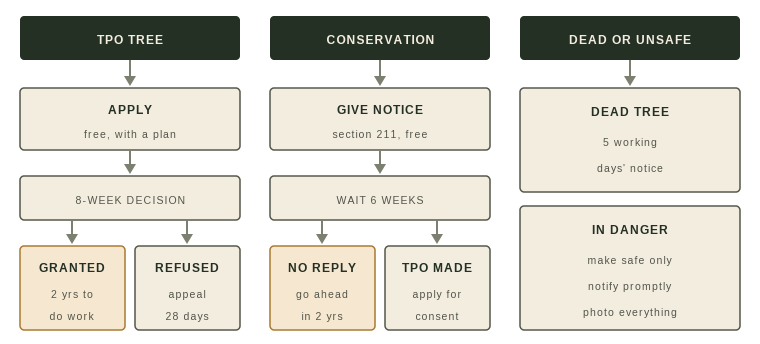
This is the part most people misunderstand. A section 211 notice is not a planning application, so the council cannot refuse it or attach conditions.
| What the council does | What it means for you |
|---|---|
| Tells you it has no objection | You can start straight away, without waiting six weeks |
| Says nothing for six weeks | You can do the work described, within two years of the notice date |
| Makes a Tree Preservation Order | The work is stopped. You must apply for TPO consent if you still want it |
The two-year window matters. If you give notice and then leave it three years, you need to give notice again.
A TPO in response is not the end of the road. Most reasonable work, like a sensible reduction, is still granted on a consent application.
If you want to protect a tree rather than work on it, see how to get a Tree Preservation Order.
Exemptions: when you do not need to give notice
The guidance lists a short set of exceptions. Everything else needs notice.
| Exemption | Detail |
|---|---|
| Small trees | Stem diameter 75mm or less, measured over the bark 1.5 metres above ground |
| Thinning | Stems up to 100mm, removed only to help other trees grow |
| Dead trees | Give five working days’ written notice instead of six weeks |
| Immediate danger | Do only the work needed to make it safe, with notice as soon as practicable |
| Fruit trees | Trees cultivated for fruit production as a business, such as commercial orchards |
| Felling licence | Work covered by a Forestry Commission felling licence |
On multi-stemmed trees, if any stem tops 75mm at 1.5 metres, the exemption does not apply. For dead or dangerous trees, photograph everything first. Leeds City Council also asks for photos of the whole tree and the problem.
Not sure if a tree is genuinely dangerous? Our guide to signs of a dangerous tree covers what to look for.
Felling licences: when they apply (rarely in a garden)
A felling licence comes from the Forestry Commission, not the council. It controls the felling of larger volumes of timber, mostly in woodland and on farms.
Under the government’s felling licence guidance, you need one to fell more than 5 cubic metres in a calendar quarter. However, trees in gardens, orchards, churchyards and public open spaces are exempt.
So for almost every house in Leeds or York, a felling licence is not needed. The conservation area notice still is. If a licence is needed, the Forestry Commission notifies the council for you.
Fines for getting it wrong
Working on a conservation area tree without notice is a criminal offence. It carries the same penalties as breaching a TPO.
| Offence | Penalty set out in government guidance |
|---|---|
| Felling, uprooting or wilfully destroying a tree | Up to £20,000 in the magistrates’ court; unlimited in the Crown Court |
| Other unauthorised work, such as lopping | Up to level 4 on the standard scale (currently £2,500) |
| Any tree removed without notice | Duty to plant a replacement of suitable size and species |
The replacement duty passes to the next owner, so it can surface when you sell. “I didn’t know” is not a defence.
How we handle conservation area trees in Leeds and York
We are based in Garforth and have worked across Leeds since 2012. We carry £5m public liability insurance and our team holds NPTC Level 2 (CS30, CS31, CS38).
- We check the status of every tree before we quote.
- We write and submit the section 211 notice, with a numbered plan and photos.
- We wait out the six weeks with you and book the work in for after.
- If the council makes a TPO, we prepare the consent application.
Whether it is a crown reduction in Roundhay or felling in York, the notice is just part of the job.
Book a free site visit through our tree surveys and TPO applications page, or call Jack on 07563 634995, and we will give you an honest view.