Most people who search how to get a Tree Preservation Order are worried about a tree they love: a big oak on the street, a copper beech next door, a row of limes on a plot that has just gone up for sale. The good news is that anyone can ask the council to protect a tree, and it costs nothing.
Before anything else, run a free TPO check on the postcode. Plenty of trees across Leeds and York are already protected, and you may find the work is already done.
Check whether the tree is already protected
A tree can be protected in two ways. It can have its own Tree Preservation Order (TPO), or it can stand in a conservation area, which brings its own notice rules. Either way, the tree already has a level of legal protection.
- Use our postcode checker. Our free TPO checker searches the national planning register for TPOs and conservation areas near the address in seconds.
- Ask the council. Not every council has published its full register to the national data yet, so the council’s tree team holds the final word.
- Look for old paperwork. If the house sale went through a solicitor, the local land charges search lists any TPO on the property.
If the TPO check shows nothing, read on. If it shows a protection, skip to the section on getting consent.
Who can ask for a Tree Preservation Order
Anyone. You do not need to own the tree, live next to it or have any planning knowledge. Councils make orders on their own initiative and in response to requests from residents, parish councils and community groups.
The government’s guidance on Tree Preservation Orders confirms councils can act on a request from “any other party”. There is no application fee and no standard form for a request.
| Your situation | Can you ask for a TPO? |
|---|---|
| The tree is in your own garden | Yes |
| The tree is on a neighbour’s land | Yes, they will be notified and can object |
| The tree is on a development site or a plot for sale | Yes, and this is where requests most often succeed |
| The tree is on council or highway land | Yes, though councils often manage their own trees without orders |
What the council looks for
A council will not protect every attractive tree. Under the government guidance, it weighs two separate tests, and a strong request answers both.
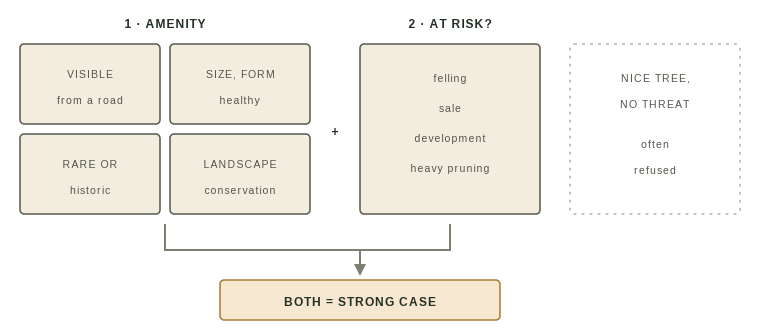
Amenity is about public benefit. The tree should be visible from a road, footpath or other public place, be in reasonable health, and add something to the local area. Rarity, historic links and a place in a conservation area all help.
Expediency is about risk. If nobody is planning to touch the tree, the council may decide an order is not needed yet. A tree on a plot that has just been sold, a site with a planning application in, or one with a tree surgeon booked is a different story.
Many councils score trees with a structured method so their decisions are consistent. You do not need to know the scoring, but describing the threat clearly makes a real difference.
How to get a TPO, step by step
- Run the check. Use our TPO checker to confirm the tree is not already protected.
- Identify the tree. Note its rough position on a map, the species if you know it, and roughly how tall it is.
- Take photos. Show the whole tree and how it looks from the street or the nearest public path.
- Describe the threat. Explain what you think is about to happen and why: a sale board, a planning application, contractors on site.
- Write to the council’s tree officer. An email with the map, photos and threat is enough. Ask for an acknowledgement.
- Follow up. If the threat is immediate, say so plainly and ring the planning team the same day.
Send your request to the council that covers the address. Across our patch that means Leeds City Council, City of York Council, North Yorkshire Council for Selby and Tadcaster, Wakefield Council, or Bradford Council for Ilkley and Burley-in-Wharfedale. Our TPO check page lists which council covers which area.
Check the postcode before you write
A request for a tree that is already protected wastes everyone's time. Run a free TPO check first, then send the council a request that starts from the facts.
What happens after you ask
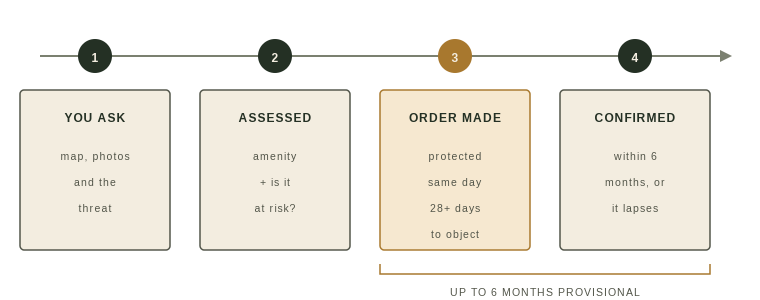
If the council agrees, it makes the order and serves notice on the owner and the neighbours. The tree is protected from that day.
| Stage | What happens | Timescale |
|---|---|---|
| Order made | Provisional protection starts immediately | Same day |
| Consultation | Owner, neighbours and the public can object or support | At least 28 days |
| Confirmation | The council confirms the order, with or without changes | Within 6 months, or it lapses |
| Afterwards | The order stays in force until the council revokes it | Indefinite |
If you supported the request, it is worth writing in during the consultation as well. Councils notice local support, and it helps if the owner objects.
Getting consent to work on a protected tree
The other meaning of “getting” a TPO is getting the council’s go-ahead to work on a tree that already has one. This is what we deal with most weeks, and it is usually straightforward.
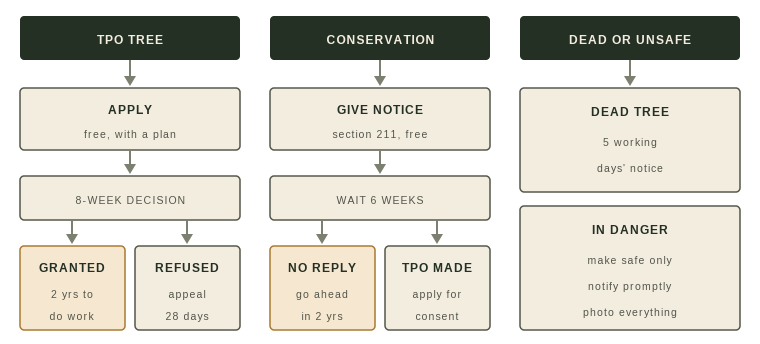
- TPO tree. Apply for consent on the standard form through the Planning Portal or the council. It is free. You need a plan showing the tree, a precise description of the work, and your reasons.
- Decision. The council has eight weeks to decide. Consent normally lasts two years, so you have time to book the work.
- Refusal. You can appeal to the Planning Inspectorate, normally within 28 days of the decision.
- Conservation area. Give the council six weeks’ written notice. If it does nothing, you can go ahead within two years. If it wants to stop the work, it makes a TPO.
- Dead trees. You still need to give the council five working days’ written notice before removing a dead protected tree.
- Immediate danger. Only the work needed to make the tree safe, with notice given as soon as practicable. Photograph everything first.
Vague applications are the main reason for delays. “Prune the tree” gets queried. “Reduce the crown by up to 2 metres, leaving a balanced shape, to clear the roof” gets decided. Our guide to crown reduction, thinning and lifting explains the wording councils expect.
What happens if a protected tree is cut without consent
Cutting down, uprooting or wilfully destroying a protected tree without consent is a criminal offence. The government guidance sets out fines that run into thousands of pounds, with serious cases sent to the Crown Court where the fine is unlimited.
Lesser unauthorised work, such as heavy lopping, carries its own fine. In either case the owner can be required to plant a replacement tree.
“I didn’t know” is not a defence, which is why we check the status of every tree before we quote. For the wider picture on permissions, read our guide to Tree Preservation Orders and conservation areas.
How we help
We work across Leeds and out to York and Selby, and TPO trees are a normal part of the job.
- We confirm the protection status of every tree on site before we quote.
- We write and submit consent applications and conservation-area notices, with the plan and the precise wording councils want.
- If a tree is genuinely dangerous or diseased, we document it properly so the evidence stands up.
- Where you need it in writing, our tree survey and report service covers it.
If there is a tree you want protected or need to work on, start with a free TPO check, then get in touch for a free site visit and we will give you an honest view on the best route.