If you have been told your tree needs “a reduction” or “a thin out” and you are not sure what the difference is, you are in good company. Most people in Leeds and York call every pruning job the same thing, but crown reduction, crown thinning, crown lifting and deadwooding are four separate operations that do very different things to a tree.
This guide explains each one in plain English, shows you a side-by-side comparison, and covers the one job a proper tree surgeon will politely refuse. The aim is that you can look at your own tree and have a fair idea of what it actually needs before anyone quotes you.
The four everyday crown operations at a glance
Here is the quick version. Each operation targets a different problem, so the right answer depends entirely on what is bothering you about the tree.
| Operation | What it does | When it is right | Rough guide cost |
|---|---|---|---|
| Crown reduction | Reduces overall height and spread while keeping the natural shape | Tree has outgrown its space, casts heavy shade, or you want to lower the sail area | £400 to £900 per tree |
| Crown thinning | Removes a percentage of secondary branches to let light and wind pass; no change in size | Dense canopy blocking light, or you want to reduce wind resistance without shrinking the tree | £350 to £800 per tree |
| Crown lifting | Removes the lowest branches to raise clearance over a path, drive or lawn | Low limbs blocking a footpath, driveway, or your view across the garden | £250 to £600 per tree |
| Deadwooding | Removes dead, dying or hazardous limbs | Any tree with visible dead branches over a target such as a path, patio or car | £200 to £500 per tree |
Those figures are a general UK guide, not a quote. The real number depends on the species, the size, the access, and what we do with the arisings. A mature oak over a conservatory is a different job to a young rowan in an open garden.
Crown reduction: making the tree smaller, keeping its shape
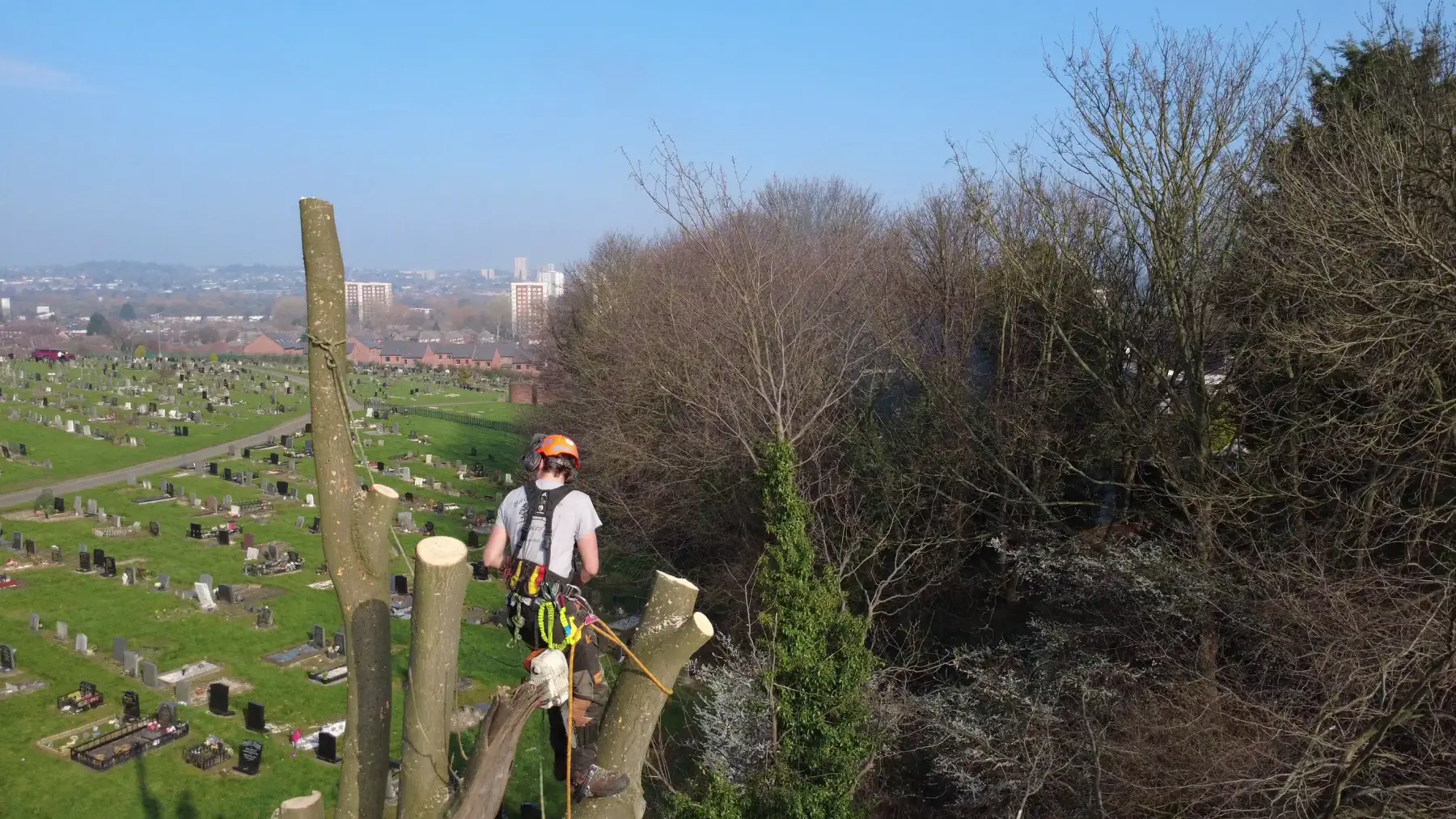
Crown reduction shrinks the height and spread of the canopy while keeping the tree looking like itself. We cut each leader and branch back to a suitable smaller side branch that can take over as the new growing point. Done well, a passer-by should not be able to tell it has been pruned at all a season later.
It is the right call when a tree has simply outgrown its spot: too tall, too wide, throwing the whole garden into shade, or leaning its weight toward a house. Reducing the crown also lowers the “sail area”, which can help a top-heavy tree cope better in the high winds we get across east Leeds and out toward York.
Reduction is usually described as a figure, for example a “two metre reduction” or a reduction “by around 20 percent”. That keeps the conversation honest and keeps us inside the 30 percent rule below.
Crown thinning: more light, same size
Crown thinning removes a proportion of the smaller, secondary branches from inside the canopy. The tree stays exactly the same height and width. What changes is density: more dappled light reaches the lawn, and wind passes through more easily instead of pushing against a solid wall of leaves.
This is often the answer when someone wants “the tree cut back” but really just wants their garden brighter. We might take out 15 to 20 percent of the secondary growth, keeping an even, balanced canopy. Over-thinning is a real mistake, because a tree stripped bare inside just responds with a thicket of fresh shoots.
Thinning does nothing about a tree that is genuinely too big. If size is the problem, you want reduction, not thinning.
Crown lifting: clearance underneath
Crown lifting removes the lowest branches to raise the clearance beneath a tree. It is the job for limbs hanging over a footpath, blocking a driveway, scraping the roof of a car, or simply spoiling the view down the garden.
There are sensible standards for clearance. As a rule of thumb, around 2.4 metres over a footpath and about 5.2 metres over a road carrying vehicles, in line with guidance from the Arboricultural Association. We lift to a natural point, never leaving stubs.
One caution: lifting the crown of a mature tree by too much in one go removes a lot of its lower leaf area and shifts the visual balance. On a big tree we lift gradually rather than all at once.
Deadwooding: the safety trim
Deadwooding is the simplest to explain. Trees naturally shed lower and inner branches as they grow, and those dead limbs eventually fall. If they hang over a patio, a path, a shed or a parking spot, we remove them before they choose their own moment.
It is not really cosmetic; it is a safety and hygiene job. A good deadwooding also gives us a close-up look at the whole crown, which often flags other issues early.
The 30 percent rule
There is a golden rule that sits behind all of this. A healthy tree should not lose more than roughly 30 percent of its live crown in one operation. This comes from the British Standard for tree work, BS 3998, and it exists because every leaf is a solar panel feeding the tree.
Strip off too much foliage at once and you starve the tree, stress it, and trigger a mass of frantic regrowth. If a tree genuinely needs more taken off than that, the honest answer is to stage the work over two or three years, or to consider whether the right tree is in the right place at all.
Why topping is not on the list
You will notice topping is nowhere above. That is deliberate. Topping means cutting the main stems back to stubs with no regard for shape or for leaving a healthy branch to grow on. It is the “just chop the top off” request, and it is one of the few jobs I will turn down.
| What topping does | Why it is a problem |
|---|---|
| Cuts stems to blunt stubs | Large open wounds cannot heal over and let decay straight in |
| Removes most of the canopy at once | Starves and severely stresses the tree, well past the 30 percent rule |
| Forces dense “water sprout” regrowth | New shoots are weakly attached and prone to snapping out in wind |
| Ignores the tree’s form | Leaves it disfigured, then bigger and more hazardous within a few years |
A topped tree is more dangerous within a few years, not less, and it never regains its natural shape. The Woodland Trust is blunt about the practice too; see its guidance on caring for and pruning trees. Where an owner genuinely wants a tree kept small on a fixed cycle, the correct method is a proper pollarding regime, started young and repeated. That is a different discipline with its own rules, covered in the guide to pollarding.
Bracing and cabling: the alternative to felling
Sometimes the issue is not the size of the crown but a structural weakness: a weak fork, a split limb, or two co-dominant stems pulling apart. The instinct is to fell the tree. Often there is a better option.
Tree bracing and cabling installs a flexible cable or a rigid brace between limbs to support the weak point and limit how far it can move or split. It does not make the tree rigid; it shares the load and buys the tree many more safe years. It is the classic save-the-tree measure for a much-loved mature specimen.
Bracing is a specialist job that follows the same British Standard, and it needs inspecting periodically once fitted. It is not a fix for a tree that is already failing, but for a sound tree with one structural flaw it is often the right answer.
Send us a photo and we will tell you straight
If you genuinely do not know whether your tree needs a reduction, a thin, a lift or nothing at all, WhatsApp us a photo or book a free site visit and we will give you an honest answer, not an upsell.
Timing, and the checks that come first
When each job is best done depends mainly on the species. Most broadleaf trees are pruned in the dormant season, late autumn through winter. A few, such as the cherry family, are safer pruned in summer to dodge disease. There is a full breakdown in the best time for tree surgery guide.
Before any crown work, one check matters more than timing: is the tree protected? If it carries a Tree Preservation Order or stands in a conservation area, you need council consent before a single cut, whether that is Leeds City Council or City of York Council. Working on a protected tree without permission is a criminal offence with real fines.
We check the designation for you as part of quoting. If consent is needed we will tell you, and we can help with the application before we lift a saw.
If you want to see exactly how a reduction is planned and specified, our crown reduction service page walks through it. Birdsall Tree Services has worked to ARB Approved standards across Leeds and West Yorkshire since 2012, fully insured with £5m public liability, and we are steadily covering more work east toward Tadcaster, Selby and York.
Whatever your tree is doing, the first step is the same. Tell us about your tree and we will help you work out which of these it actually needs, or whether it needs nothing at all.