If you are worried a tree in your garden might be dangerous or dying, the quickest answer is this: look for fungal brackets at the base, dead or hanging branches, large cavities, cracks in the trunk, and any sudden new lean. We assess trees like this every week across Leeds and out to York, and the single most useful thing to understand is that a defect only becomes a real danger when there is something below it to hit.
The warning signs, at a glance
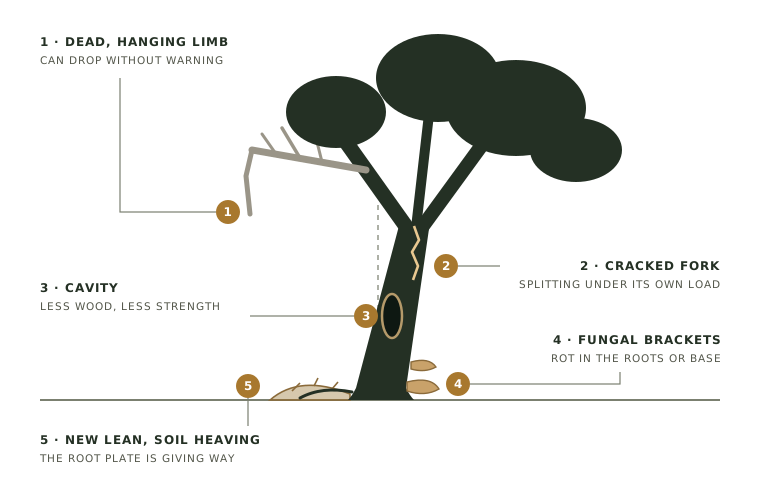
No single sign is a guaranteed death sentence, and a healthy-looking tree can still have a hidden problem. But the list below is what an arborist actually looks for. Several of these together, or any one of them over a target like a house or footpath, is a reason to get the tree assessed.
| Sign | Why it matters |
|---|---|
| Fungal brackets or conks at the base or on the trunk | Can indicate root or butt rot decaying the wood that holds the tree up |
| Dead or hanging branches (“widowmakers”) | Can drop without warning, especially in wind |
| Large cavities or hollowing | Reduced wood means reduced strength in the trunk or a main limb |
| Cracks or splits in the trunk or a major fork | A sign the tree is already failing under its own load |
| A sudden new lean, with soil heaving or roots lifting on one side | Often means the root plate is starting to give way |
| Bark falling away in patches | The tissue beneath has died, hinting at decay or disease |
| Lots of deadwood through the crown | Widespread dieback suggests the tree is in decline |
| ”Included bark” in tight V-shaped forks | A weak union that can split as the limbs grow heavier |
| An unusually early or sparse leaf canopy | Thin, late or patchy leaf-out is a classic sign of a stressed or dying tree |
If you can safely photograph any of these, do. A clear photo of the base, the trunk and the whole tree tells us a lot before we even arrive.
A species note: ash and ash dieback
Ash deserves a special mention. Ash dieback is now widespread across Yorkshire, and an affected ash does not just decline slowly. As the disease takes hold the timber becomes brittle and unpredictable, so limbs can snap and whole trees can fail with very little warning.
That brittleness also makes a diseased ash dangerous to climb, which changes how it has to be removed. If you have an ash showing thinning crown, blackened leaves or diamond-shaped lesions, read our dedicated guide on ash dieback in Yorkshire and treat it as a priority for assessment.
The idea that matters most: risk is defect plus target
This is the concept that changes how you should read every sign above. In arboriculture, risk = defect + target.
A defect is the physical problem: the crack, the fungal bracket, the cavity, the lean. A target is whatever the tree could hit if it failed: a house, a car, a road, a footpath, a boundary, a play area, or a person.
The same defect carries wildly different risk depending on the target.
- A hollow trunk on an oak in the middle of an empty field is often low risk. There is nothing to hit, and a hollowing tree can stand for decades.
- The exact same hollow trunk on an oak leaning over your kitchen is a serious concern, because the target is high value and occupied.
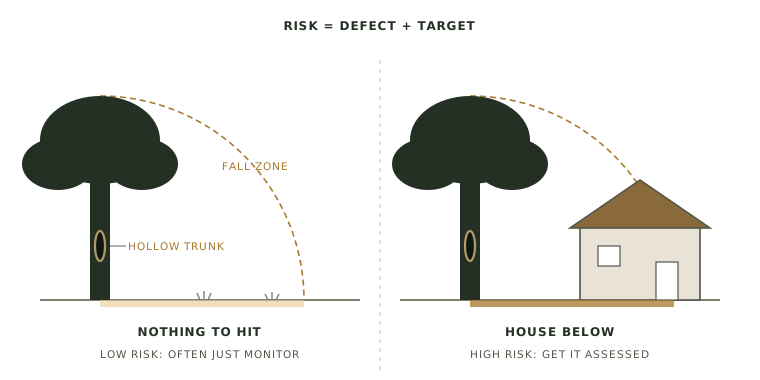
This is why a good arborist never quotes a tree as “dangerous” or “safe” from a photo of the trunk alone. We need to know what is underneath it and around it. It is also why the honest answer is sometimes “leave it alone and monitor it” - a defect with no target may not need any work at all.
What to do about an unsafe tree
If you think a tree is dangerous, work through these steps in order.
- Do not try to climb or fell it yourself. DIY tree felling is how serious injuries happen, and a defective tree behaves unpredictably under a saw.
- Keep the area clear. If a limb is obviously hanging or cracked, stop parking, sitting or playing beneath it until it has been dealt with.
- Get it assessed by a qualified, insured arborist. A proper inspection tells you whether the tree needs work, and how urgently. Our tree survey and inspection service is built for exactly this.
- Plan the work rather than wait for a failure. A controlled takedown or prune is safer, tidier and cheaper than an emergency call-out after a limb has already come down on the shed.
The pattern to avoid is the classic one: a known problem, ignored through a calm summer, that becomes a 2am emergency in the first big autumn storm. Planned is always cheaper than emergency.
Send us a photo and we'll give you an honest read
If a tree is worrying you, WhatsApp us a photo of the base, the trunk and the whole tree, or book a free site visit. We'll tell you straight whether it needs work or can safely be left alone.
If the tree is protected
A tree being dangerous does not automatically mean you can remove it without permission. If it has a Tree Preservation Order (TPO) or stands in a conservation area, most work still needs written consent from the council.
There is an exemption for a tree that is dead, or that presents an immediate risk of serious harm. But the exemption is narrow and the burden of proof sits with you, so do not rely on it lightly. According to the government’s guidance on tree preservation orders and trees in conservation areas, you should give the council notice and only carry out the minimum work needed to remove the danger.
In practice that means: photograph and document the defect thoroughly before any work, keep that evidence, and tell the council (Leeds City Council or City of York Council) first wherever it is safe to wait. Our guide on tree preservation orders explains the process, and you can run a quick check on our TPO checker.
How Birdsall can help across Leeds and York
Birdsall Tree Services assesses trees across Leeds and out to York and Selby. Established in 2012, we carry £5m public liability insurance and hold NPTC Level 2 (CS30/CS31/CS38), working to ARB Approved standards.
A site visit is free. We will give you an honest view, and that genuinely includes telling you when a tree can safely be left alone rather than talking you into work you do not need. If it does need attention, whether that is a single prune, a full takedown, or a same-week emergency, you get a free written quote first.
If a tree is worrying you, tell us about your tree and we’ll take a look. If a tree has already come down or split in a storm, read what to do when a tree comes down first, and our emergency tree service can get to you fast.