Tree roots near a house worry more people in Leeds and York than almost anything else we get asked about. The honest answer is that a root barrier is sometimes the right fix, but it is an engineering job rather than a tree surgery one.
Most trees close to a house never cause a structural problem at all. Here is how roots behave, when a barrier gets specified, where it falls short, and what we can genuinely do.
How tree roots actually behave
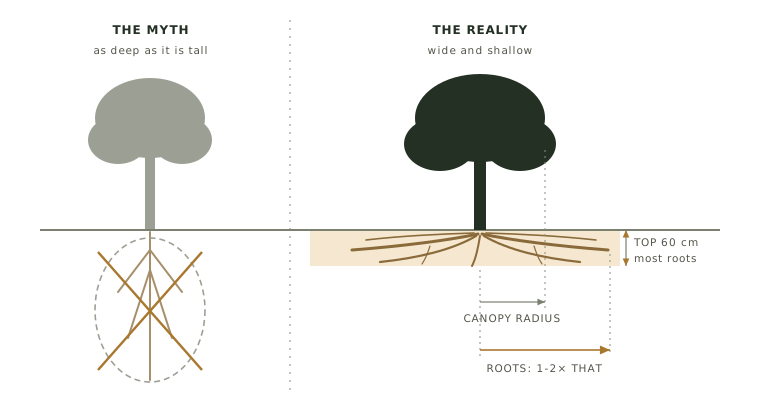
Most people picture roots as a mirror image of the canopy, as deep as the tree is tall. They are not.
- Most of the root mass sits in the top 60cm of soil, where the oxygen, water and nutrients are.
- Roots spread outwards one to two times the canopy radius, sometimes further.
- Roots do not “seek out” foundations or drains. They follow moisture gradients and grow where conditions are easiest.
- Direct pressure damage from roots mostly affects paths, driveways, garden walls, patios and old clay drains, rarely modern house foundations.
A root lifting a flag on your path in Garforth is a root being a root, not evidence that the tree is undermining your house.
Can tree roots cause subsidence?
Yes, but the mechanism is indirect and it depends almost entirely on the soil. Tree-related subsidence is a shrinkable clay problem.
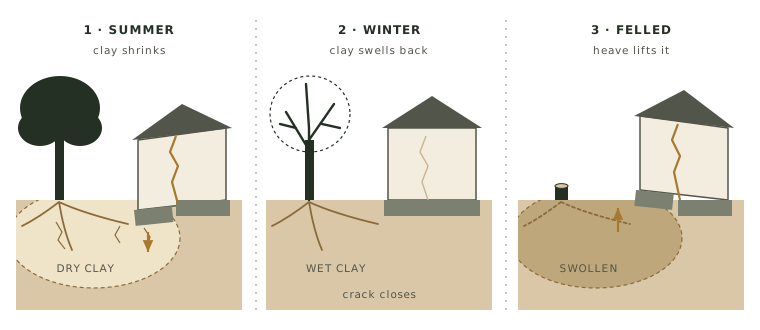
On clay, a tree draws water out of the ground through the summer. The clay loses volume and shrinks. In a wet winter it takes water back and swells.
If the clay under one corner of your foundations is drying more than the rest, that corner moves and cracks appear above it.
The British Geological Survey explains the shrink-swell mechanism in detail on its clay shrink-swell page.
On sandstone, limestone, sand or gravel there is very little to shrink. The same oak in the same spot is a different level of risk entirely.
Leeds and York geology is patchy
This is where the “how close can a tree be to a house” question gets genuinely local. The ground across our patch changes street by street.
| Area | Typical ground | Shrink-swell concern |
|---|---|---|
| Parts of north and east Leeds, Wakefield, Vale of York | Clay-rich glacial till and boulder clay | Higher, varies with clay content |
| Garforth, Wetherby, Tadcaster ridge | Magnesian limestone | Low |
| West Leeds, Otley, Pennine fringe | Coal Measures sandstone and shale | Low to moderate |
| Along the Ouse and Aire, central York, Selby | Alluvium and river terrace deposits | Variable, can be soft |
Two houses on the same road can sit on different deposits where till thins out over rock.
The only way to know what is under your footings is a soil investigation, a trial pit or borehole with laboratory testing. A map or a garden spade will not tell you.
Which trees have the highest water demand
The NHBC Standards sort common species into water demand categories for foundation design. The full tables are in NHBC Standards chapter 4.2, Building near trees. The summary below follows those categories.
| Water demand | Species |
|---|---|
| High | Oak (Quercus robur), willow (Salix spp.), poplar (Populus spp.), elm (Ulmus spp.), eucalyptus (Eucalyptus gunnii), cypress and leylandii (Cupressus and x Cuprocyparis leylandii) |
| Moderate | Ash (Fraxinus excelsior), lime (Tilia spp.), sycamore (Acer pseudoplatanus), horse chestnut (Aesculus hippocastanum), beech (Fagus sylvatica), rowan (Sorbus aucuparia), apple, pear, plum and cherry |
| Low | Birch (Betula spp.), holly (Ilex aquifolium), hornbeam (Carpinus betulus), hazel (Corylus avellana), laburnum, magnolia |
A high demand tree on shrinkable clay close to shallow Victorian footings is the combination that engineers take seriously. A birch on limestone in Wetherby is not.
What a root barrier for trees actually does
A root barrier for trees is a vertical membrane or rigid panel installed in a trench between the tree and the thing you are protecting, usually a foundation or a drain run.
It is normally specified by a structural engineer or by the insurer’s loss adjuster as part of a subsidence remedy.
- The trench typically needs to reach below the active root zone and extend well beyond the canopy edge to be effective.
- It works best when installed at planting time, so the roots grow around it from the start.
- Installation is groundworks and engineering work. We do not install root barriers and we would be wary of any tree surgeon who says they do.
A root barrier is also used in a completely different way as a honey fungus control, isolating infected ground from healthy roots, which I cover in our honey fungus guide.
Where a barrier falls short
Retrofitting a barrier beside an established tree is where things get difficult, and it is worth understanding the limits before anyone starts digging.
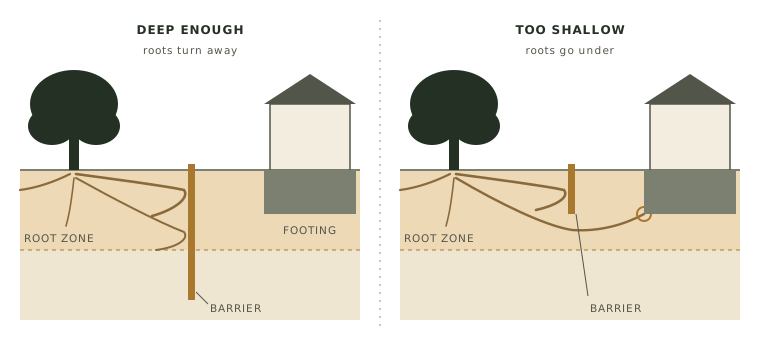
- Roots follow moisture, so they go under or around a barrier that is too shallow or too short.
- Cutting a trench near a mature tree severs the structural roots on that side. The tree loses anchorage and can become unstable in exactly the storms you were worried about.
- If the tree is protected by a TPO or sits in a conservation area, cutting roots counts as works to the tree and needs consent from Leeds City Council, City of York Council or North Yorkshire Council. Use our TPO check first and read the TPO guide.
- A barrier does nothing about the moisture the tree is already drawing from beneath the house.
| Option | What it does | Main drawback |
|---|---|---|
| Root barrier | Redirects new root growth away from foundations | Retrofit severs roots; roots can bypass it |
| Crown reduction | Cuts water demand and canopy load while keeping the tree | Needs repeating on a cycle |
| Felling | Removes the water demand entirely | Heave risk on clay; loses the tree |
| Tree report and monitoring | Establishes whether the tree is actually the cause | Takes a season or more |
Heave: why felling can make it worse
On clay, taking out a mature tree does not simply end the problem. The soil that has been kept dry by the roots for decades starts to take water back, and as it rewets it swells upwards.
That is heave, the third panel in the diagram above, and it can lift and crack a foundation just as subsidence drops it.
This is the main reason engineers and insurers often prefer a staged crown reduction over felling.
Cutting the canopy back reduces the volume of water the tree pulls each summer, letting the soil moisture rebalance gradually rather than all at once. Our crown reduction, thinning and lifting guide explains what a proper reduction looks like.
Not sure the tree is really the problem?
Book a free site visit and we will give you an honest view on whether that tree is a risk or just big. If you need it in writing for an insurer or lender, our tree survey and report service covers it, or WhatsApp us a photo for a first opinion.
The insurer’s role in a subsidence claim
If you have cracks you think are tree-related, the right first call is your home insurer, not a tree surgeon. Subsidence is normally covered, and the insurer appoints a loss adjuster and engineer who run the process.
- The engineer inspects the cracks and the surrounding trees.
- Trial pits or boreholes establish the soil type and whether roots are present under the footings.
- Level and crack monitoring runs through at least one summer and winter to confirm seasonal movement.
- Only then is a remedy agreed, which might be reduction, removal, a barrier or underpinning.
Do not fell a tree pre-emptively because you have spotted a crack. You may destroy the evidence the claim depends on, and on clay you may trigger heave. The Association of British Insurers sets out how subsidence claims work.
The legal checks before cutting anything
Before any root cutting, reduction or felling, check protection status. A TPO or conservation area applies to roots as much as branches, and the fines for unauthorised works are serious.
If the tree belongs to a neighbour, you can cut roots that cross onto your land back to the boundary, but you become liable if that work destabilises the tree and it fails.
You cannot touch roots or branches on their side without permission. Our neighbours’ trees law guide covers the detail.
What we actually do about trees near houses
We are tree surgeons, so our part of this is the tree rather than the trench.
- Crown reduction to cut the tree’s water demand and canopy load while keeping it standing. See our crown reduction service.
- Felling where a tree genuinely has to go, in sections where access is tight. See tree felling.
- Written tree reports for mortgage lenders, insurers and subsidence investigations, explained in our tree survey for mortgage guide.
Every job gets a free site visit and a written fixed quote, with no minimum job size.
Across Leeds and out to York, if a tree near your house is worrying you, start with a free crown reduction quote or a written tree report, and we will tell you straight whether it is a problem worth spending money on.