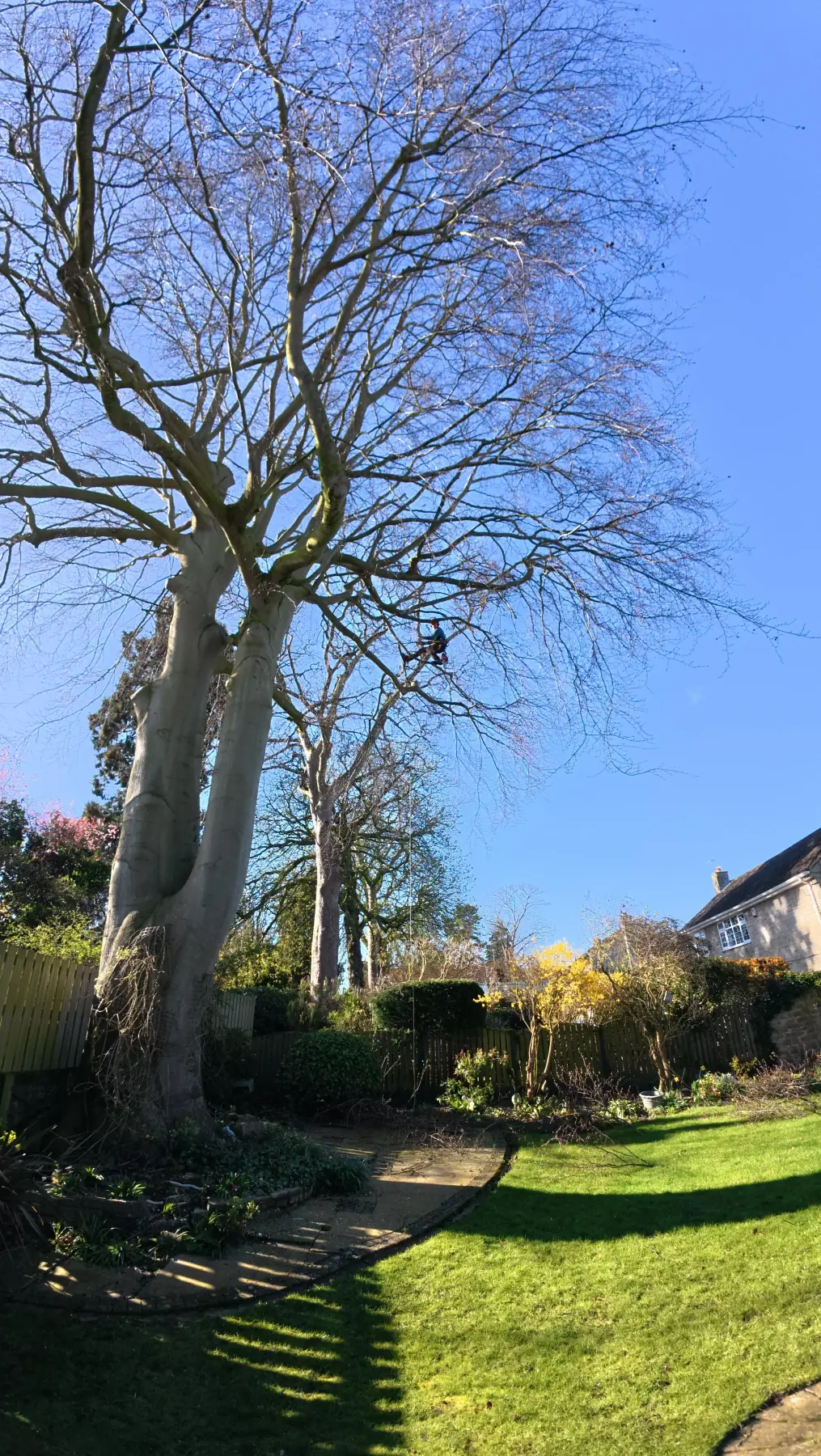
Pruning eucalyptus is best done in late winter to early spring, roughly February to March, and the tree takes far harder cutting than most people dare give it. In Leeds and York gardens the question is not whether you can prune it, but how soon.
A eucalyptus tree bought as a pot plant with silver-blue leaves is usually Eucalyptus gunnii, the cider gum. Left alone it heads for 15 to 25 metres. Here is why it bolts, when to cut, and when to call it a day.
Why garden eucalyptus gets away from you
Eucalyptus was planted heavily in 1990s and 2000s new-build gardens across Garforth, Rothwell, east Leeds and the York estates. Twenty-odd years on, those shrubs are towering over semis, and that is where most of our calls come from.
The species has a set of habits that make it a poor fit for a small plot:
- Growth rate: a metre or more a year once established, sometimes two in a wet summer.
- Shallow, wide root plate: fine for Tasmania, less so in heavy Leeds clay, so taller trees rock in the wind.
- Tall thin stems with a heavy crown: the weight ends up at the top, where the leverage is worst.
- Brittle wood: limbs snap in gusts rather than bending, and bark peels off in sheets.
- Two kinds of leaf: the rounded, blue juvenile foliage florists love, then sickle-shaped grey-green adult leaves once the tree matures.
On the flat, open ground east of Leeds towards Selby and York there is little shelter, and wind-rock is how a eucalyptus goes from “a bit big” to “leaning at the conservatory” in one winter.
E. gunnii is the common one. E. pauciflora subsp. niphophila, the snow gum, is smaller and better behaved. E. dalrympleana, the mountain gum, is just as fast and gets taller.
When to prune eucalyptus
The RHS guidance on growing eucalyptus is to prune in late winter to early spring, once hard frosts are past and before the sap rises. In Yorkshire that means February into March.
| Month | Pruning eucalyptus? | Why |
|---|---|---|
| October to December | Avoid | Wounds stay open through frost; soft regrowth gets killed back |
| January | Avoid unless urgent | Still deep frost risk in Leeds and York |
| February to March | Best window | Frosts easing, growth about to surge, wounds close quickly |
| April to May | Acceptable | Fine for light shaping, but the tree is already putting energy into new shoots |
| June to September | Light work only | Removing a snapped limb is fine; hard cutting wastes the season’s growth |
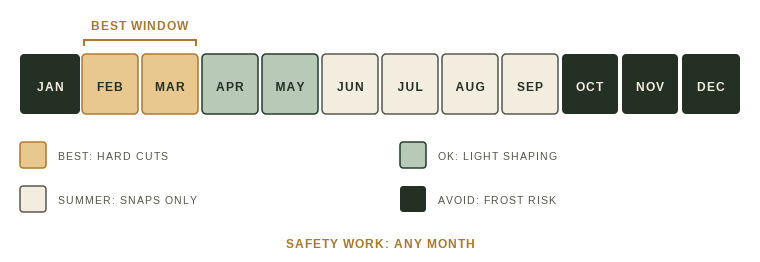
The exception is a safety job. A cracked limb over a path or a stem rocking in the ground gets dealt with whatever the month. Our wider guide to timing is the best time for tree surgery.
Four ways to deal with it
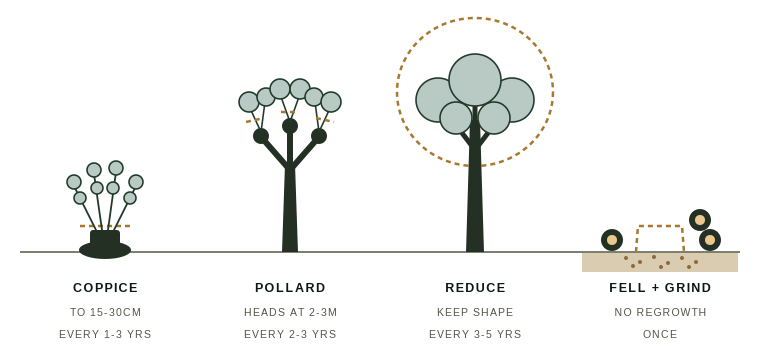
Eucalyptus regrows from dormant buds under the bark and from a lignotuber, a swollen woody base packed with buds, so it shrugs off cutting that would kill a beech or a birch.
| Approach | What it involves | How often | Best for |
|---|---|---|---|
| Coppicing (stooling) | Cut every stem back to a low stump, 15-30cm | Every 1-3 years | Keeping it as a shrub with juvenile foliage |
| Pollarding | Cut back to a framework at 2-3 metres | Every 2-3 years | A small tree shape above a fence line |
| Crown reduction | Shorten the crown back to growth points, keep the structure | Every 3-5 years | An established tree you want to keep |
| Felling and stump grinding | Remove the tree, grind the stump below ground | Once | A tree that has outgrown the plot or sits too close to the house |
Twenty years of growth does not have to mean losing the tree
A well-planned crown reduction can bring a big eucalyptus back to a size the garden can live with. WhatsApp us a photo and we will give you a ballpark and an honest view.
Coppicing and pollarding: keeping it small
Coppicing is the simplest eucalyptus pruning there is. Every one to three years, in late winter, cut every stem back to a stump 15 to 30cm high.
The lignotuber throws up new shoots carrying the round, blue juvenile leaves. This is how cut-flower growers manage it.
Thin the regrowth to five or six strong shoots in early summer. Coppiced gunnii settles at two to three metres between cuts.
Pollarding suits a garden where you want something tree-shaped above the fence. Establish a framework of three to five short limbs at two to three metres while the tree is young, then cut back to those heads every two to three years.
Eucalyptus is one of the few garden species that genuinely pollards well. Our pollarding guide covers the method, the difference between pollarding and topping, and why the cycle cannot just stop once you have started.
Crown reduction and felling: the established tree
If you have inherited a 12 to 20 metre eucalyptus that was never coppiced or pollarded, the choice narrows.
A crown reduction shortens the whole canopy back to suitable growth points, taking height and spread off while keeping a natural shape. On eucalyptus we reduce modestly and plan to return in three to five years, because the regrowth is vigorous and heavy.
Our crown reduction, thinning and lifting guide explains the difference between the three. Reduction is worth it when the tree is sound, reasonably placed and you like it. It is a poor bet when:
- the stem is leaning or rocking at the base
- the tree sits within a few metres of the house or a neighbour’s extension
- the crown is already over a road, a conservatory or a greenhouse
- the trunk has long vertical cracks or large areas of dead bark
In those cases felling is the honest answer. In a tight garden it comes down in sections from a climber, and it is one of the more common removals we do across Leeds and out to York. See tree felling and removal.
Whatever you do, deal with the stump. A eucalyptus stump left in the ground will have a thicket of shoots by the following summer. Stump grinding takes it below ground level and ends the problem.
As a general UK guide, not a quote: crown reduction on a medium tree runs £400-£900, small tree removal £150-£400, medium removal £400-£900, and stump grinding £60-£250 per stump.
Young trees: formative pruning
The cheapest pruning eucalyptus ever gets is in its first three years. Decide what you want the plant to be and shape it then.
- Stake loosely. A tall thin eucalyptus leans in its first winter. Use a short stake and a soft tie, and remove it after two years so the stem thickens.
- Pick a form. For a tree, prune to a single leader and remove competing stems. For a shrub, cut the whole plant back to 30cm in its second spring to force multiple stems.
- Cut early, not late. Cutting back a two-year-old plant is a secateurs job. Leaving it ten years makes it a climber’s job.
- Water in the first two summers. Drought-stressed eucalyptus drops branches.
DIY or tree surgeon?
Coppicing a young plant at knee height with loppers and a bow saw is a reasonable Saturday morning. The line moves quickly.
| Situation | Reasonable DIY? |
|---|---|
| Shrub under 4 metres, cutting from the ground | Yes |
| Anything over about 4 metres | No |
| Branches over a boundary, road, path or conservatory | No |
| Any chainsaw use off the ground | No, this needs an NPTC-certified climber |
| Leaning stem or cracked limb | No, treat as a safety job |
Eucalyptus stems are brittle and whippy, and the bark peels under your hands and feet. It is a bad tree to be up a ladder in.
We climb it on NPTC CS38 tickets, rig sections down where there is no drop zone, and carry £5m public liability insurance.
The wood, the bark and the mess
Eucalyptus drops limbs and sheds bark in long strips all year, so a big one over a patio means constant clearing. Dead limbs also come down without warning in a dry summer.
The upside is the timber. Eucalyptus burns hot once seasoned for a year. We can leave logs cut to length if you have a burner, or chip the brash on site.
Permission check before you cut
Most garden eucalyptus are young and not protected, but a tall specimen in an older garden can sit under a Tree Preservation Order or in a conservation area. Leeds City Council, City of York Council and North Yorkshire Council all hold these records.
Run your postcode through our free TPO checker before any significant cutting. Our tree preservation order guide explains what counts as work and how the six-week notice period works.
The short version on pruning eucalyptus: cut in late winter, cut harder than feels comfortable, and keep to a cycle.
If yours has outgrown the garden, book a free site visit and we will give you an honest view on whether a crown reduction will hold it or felling is the better money.