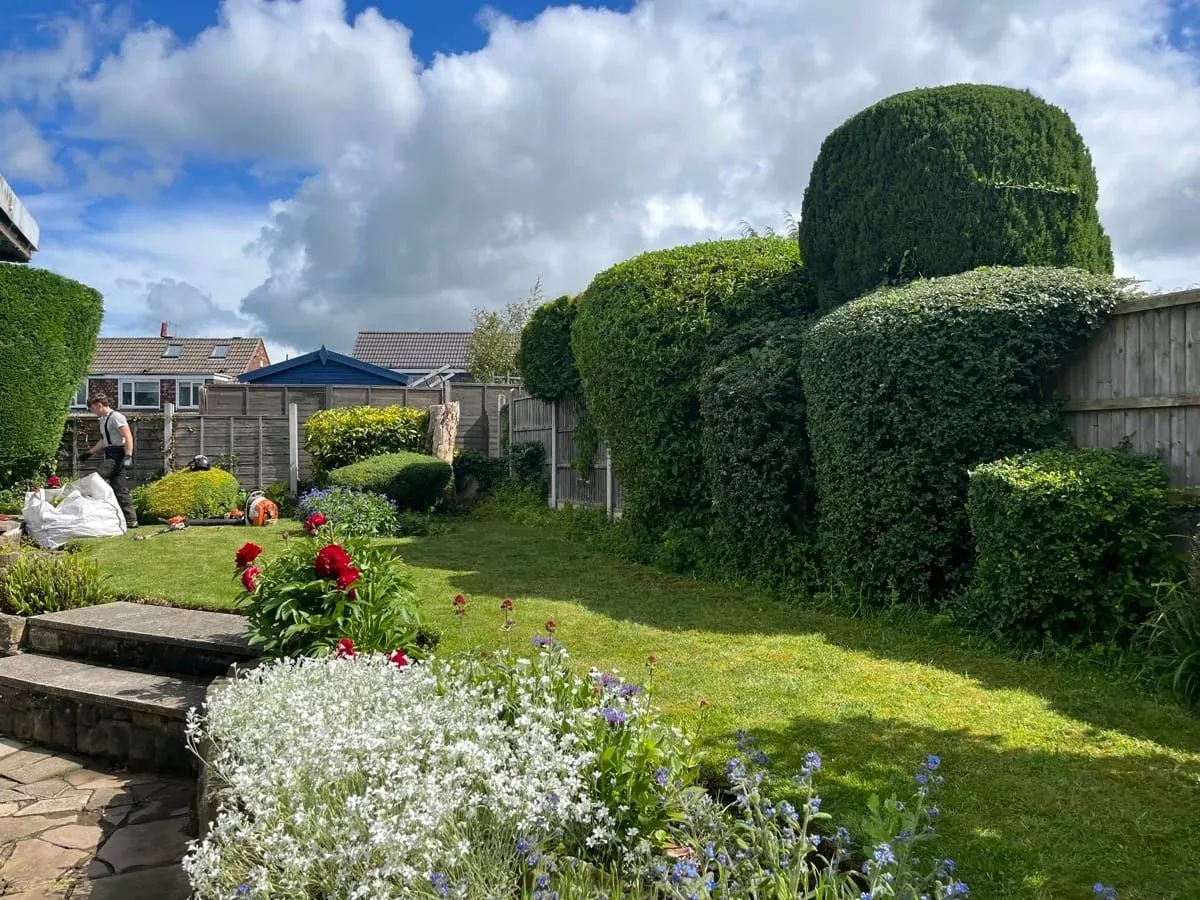
If you are asking when can you cut hedges in the UK, the honest answer is that there is no banned month, but there is a right month for each species.
Across Leeds and out to York, most hedge work happens from late summer through late winter.
This is the hub guide for our hedge timing content. It gives you one calendar covering every common hedge species, explains the three types of cut, and tells you when a hedge has gone past trimming and needs a hard reduction or taking out.
The law in one paragraph
No month bans hedge cutting. The law protects the bird’s nest in use, not the date. Under section 1 of the Wildlife and Countryside Act 1981 it is an offence to intentionally damage or destroy an active nest.
The main nesting season runs roughly March to August.
Our hedge cutting law guide covers the full picture, including high hedges and boundaries.
Hedge cutting season in Leeds and York
The traditional hedge cutting season runs from late August to the end of February, and there are practical reasons for that beyond nesting birds.
- Deciduous hedges have finished their main growth flush by August, so a cut then holds its shape until spring.
- Beech and hornbeam cut in August keep their copper leaves through winter, which is the whole point of a beech screen around villages like Garforth, Barwick and Wetherby.
- In winter you can see the structure of a bare hedge, which makes renovation cuts far more accurate.
- The garden is not in use and the arisings are easier to clear.
Conifers are the exception and the one that catches people out. Do not cut leylandii, Lawson cypress or thuja in frost, and do not cut them in a hot dry spell either.
Frost browns the cut tips and they do not recover. Heat and drought stress the plant just as you have removed a chunk of its foliage.
The conifer window is late spring to the end of August, which is why the RHS hedge pruning guidance puts formal evergreens on two or three cuts through the growing season rather than one winter cut.
So when can you cut hedges in the UK, garden by garden? It comes down to what the hedge is made of. The table below is the answer I give on site visits.
Species by month: the calendar
| Species | Best months to cut | Months to avoid | Cuts a year |
|---|---|---|---|
| Cherry laurel (Prunus laurocerasus) | May to July, tidy in late August | October to March, especially before frost | 1 to 2 |
| Beech (Fagus sylvatica) | August for the annual cut; February for renovation | April to May, just after leafing | 1 |
| Hornbeam (Carpinus betulus) | August; February for renovation | April to May | 1, or 2 if kept very formal |
| Leylandii (Cupressus x leylandii) and other conifers | Late April to end of August | September to March, any frost, any hot dry spell | 2 to 3 |
| Privet (Ligustrum ovalifolium) | May to August | November to March | 2 to 3 |
| Hawthorn (Crataegus monogyna) | Late August to September, or January to February | March to July (peak nesting) | 1 to 2 |
| Box (Buxus sempervirens) | June after the late frosts, again in late August if needed | Hot sunny days, any frost | 1 to 2 |
| Yew (Taxus baccata) | August to September; March to April for renovation | Hard frost periods | 1 |
A few notes that do not fit in a table cell:
- Laurel has big leaves that go brown and ragged if you shred them with a hedge trimmer. For a hedge you look at every day, loppers give a cleaner finish. Our laurel hedge guide goes into the detail.
- Beech wants exactly one cut, timed so the leaves stay on. Cut it in spring and you lose the winter screen. The beech hedge guide covers that and the two-stage renovation.
- Leylandii runs to the tightest calendar of the lot and has the least margin for error. Our conifer and leylandii hedge guide covers the one-third rule and the frost and drought windows.
- Box is on the list for completeness, but with box blight and box tree caterpillar now common across Leeds and York, check the hedge is healthy before you invest time in it.
- Hawthorn is a wildlife hedge first. On a rural boundary around Selby or Tadcaster, January and February are kinder to the birds than summer.
Formative, maintenance and renovation cuts
Every hedge goes through three types of cut over its life, and the timing shifts for each one.
| Type of cut | When in the hedge’s life | Best timing | What it involves |
|---|---|---|---|
| Formative | First two or three years after planting | Deciduous: winter after planting; evergreen: spring | Cutting the leader and sides back by up to a third each year so the base thickens. Skip this and the hedge is bare at the bottom for life. |
| Maintenance | Established hedge, every year | Per the species table above | Taking the season’s growth back to the established line, keeping the hedge slightly wider at the base so light reaches the lower foliage. |
| Renovation | Hedge that has got too tall, too wide or bare inside | Deciduous: late winter; evergreen: mid-spring | Cutting back hard into old wood, often the top one year and one face at a time over two or three years. Feed and mulch afterwards. |
Which hedges take hard renovation
This is the question that decides whether an overgrown hedge is a job or a removal.
| Species | Regrows from old wood? | My view |
|---|---|---|
| Yew | Yes, reliably | The most forgiving hedge there is; can be taken back to bare stems |
| Beech and hornbeam | Yes | Do the top and one face first, the other face a year or two later |
| Cherry laurel | Yes, vigorously | Can be cut to stumps and will come back; expect a bare season |
| Privet | Yes | Cut hard in spring and it will be dense again by autumn |
| Hawthorn | Yes | Traditionally laid or coppiced; takes very hard cutting |
| Box | With care | Reduce in stages and only if free of blight |
| Leylandii and most conifers | No | Will not regrow from brown wood; height can come off, sides cannot go past the green |
That last row matters. A leylandii hedge at six or seven metres can have its top taken off, because the sides stay green. But once narrowing it means cutting into brown wood, it will stay brown.
You are then choosing between a tall screen you cannot narrow, or a removal and replant.
When a hedge has got away
I see the same three situations across Leeds and York every month.
Leylandii that has got away. Planted twenty years ago as a quick screen, trimmed for a few years, then left.
Now it is a line of conifers blocking light to two gardens, and a letter has arrived from Leeds City Council or City of York Council.
Topping buys time. Usually the real answer is to take it out.
Mature beech hedges in the villages. Around Garforth, Aberford, Wetherby and the villages off the York ring road there are beech hedges eighty or a hundred years old and three metres wide.
These are worth keeping. A staged winter renovation brings them back and you still have a hedge at the end.
A hedge that has become a line of trees. Hawthorn, holly or sycamore self-seeded into an old hedge and never cut back. Once the stems are tree-sized, this is tree work.
We approach it as a crown reduction on each stem, or fell the ones with no future.
Bring it back under control, or take it out
If a hedge is past what a trimmer can fix, we will give you an honest view on a hard reduction versus a full hedge removal, or WhatsApp us a photo for a ballpark.
Whichever route you go, timing still matters. Removals can happen any month once we have checked for nests, but a renovation only works in the right window for the species.
Cut a beech hard in May or a leylandii in January and you have made the problem worse.
Working out the cost
Hard reductions and removals are priced by the job, because access, the volume of arisings and whether stumps need grinding all change the day. Our hedge removal cost guide walks through what moves the price.
Any figures on our cost pages are a general UK guide, not a quote.
If the hedge is too far gone for a trim, we are happy to look at it. We cover Leeds, Wakefield, Wetherby, Harrogate and out to York and Selby, with free site visits and a written fixed quote.
Have a read of our hedge removal service page, or send us a photo and we will tell you straight whether it is a reduction or a removal.