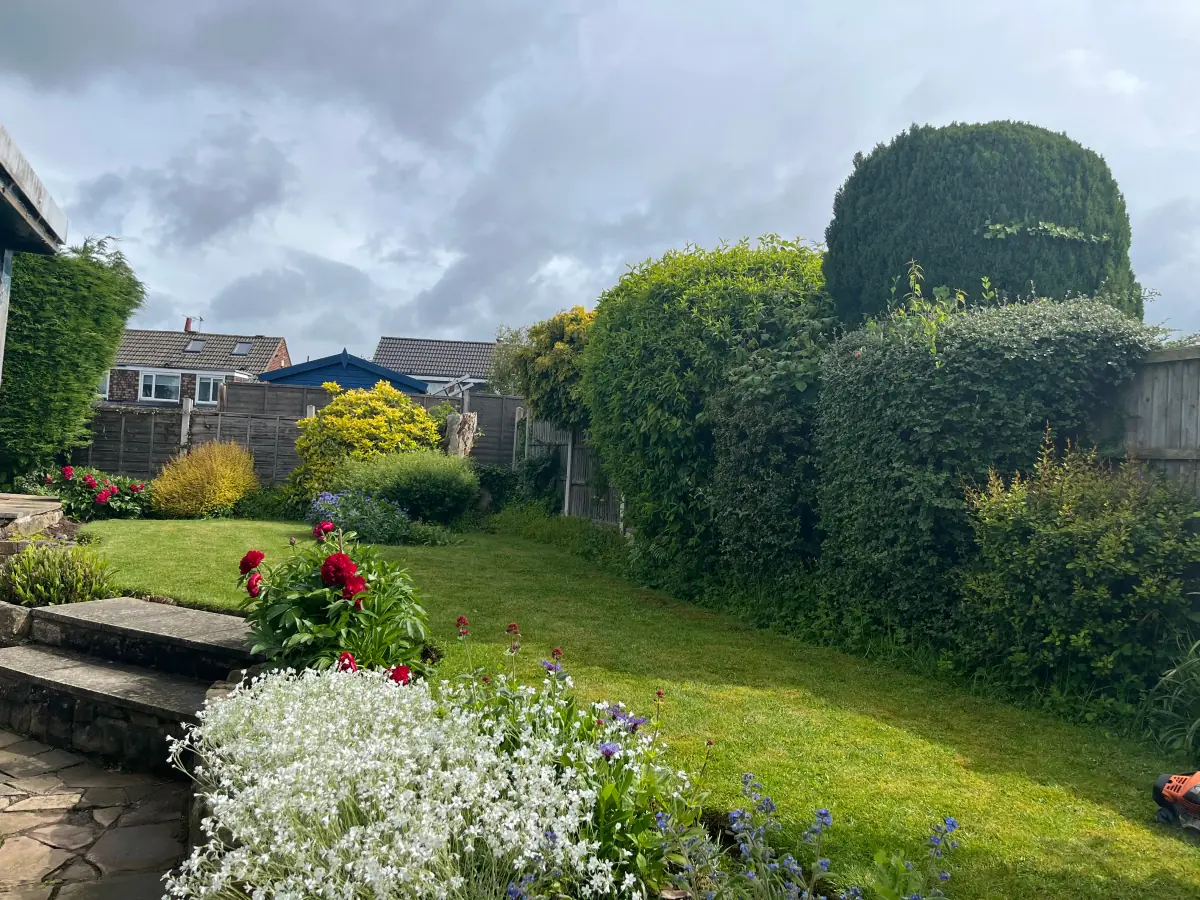
If your Leylandii or conifer boundary has outgrown its space, this is about taking it out for good rather than trimming it. We remove and heavily reduce overgrown hedges across Leeds and out to York, from big suburban conifer runs to a dead hedge that needs clearing and replacing.
To be clear up front: this guide is for the bigger jobs - full removal, or one heavy one-off reduction. If you just want a tidy annual trim, that is a different, smaller job.
When people remove a hedge
Most removals we are called to fall into a handful of reasons. The common thread is a hedge that has stopped earning its place.
| Situation | Why it usually ends in removal |
|---|---|
| Overgrown Leylandii or conifer boundary | Grown far too tall and wide, blocking light, past the point a trim can fix |
| Dead or diseased hedge | Brown, dying back or failing, no longer a screen worth keeping |
| Reclaiming a garden | A hedge eating a metre or more of usable ground you want back |
| Outgrowing its space | Pushing into paths, drives, drains or a neighbour’s plot |
| Replacing with a fence or wall | You want a defined, low-maintenance boundary instead |
What full removal involves
Full removal is not one cut. It is three stages: cut the hedge down, deal with the stumps and root plate, then clear every last bit of the arisings off site.
The stumps are the part people underestimate. Leylandii roots and other conifer roots are shallow but spread widely, so the root plate under an old hedge can be surprisingly large.
Those stumps rarely rot away quickly, and they get in the way of a new lawn, planting or a fence line. So they are usually ground out with a stump grinder, or dug out where access allows.
Conifers also will not regrow from bare brown wood once cut past the green, per the Royal Horticultural Society, which is exactly why a very overgrown run is often better gone than hacked at year after year.
Removal vs heavy reduction
You do not always have to lose the whole hedge. If you still want some screening, a one-off heavy reduction can lower and narrow it in a single visit. But there is an honest limit with conifers.
| Option | What happens | Best when | Note |
|---|---|---|---|
| Full removal | Cut down, stumps ground or dug out, site cleared | The hedge is dead, unwanted, or too far gone to save | Gone for good; ground is left ready for what’s next |
| Heavy one-off reduction | Lower the height and narrow the width in one go | You want to keep a living screen but tame its size | Only works cut back to green growth |
The catch: Leylandii and most conifers do not reshoot from bare brown wood. Cut a face back past the green and it stays brown permanently, so a hard reduction has a real limit. On a hedge that has already gone woody and bare inside, removal is often the more honest choice. If yours is still within reach of a trim, the cutting calendar and the one-third rule are in our guide to when to cut a conifer or leylandii hedge.
What drives the cost
There is no flat rate for hedge removal cost. The same length of hedge can be a half-day or a two-day job once height, species and access are factored in. These are the things that move the figure.
| Cost driver | Why it matters |
|---|---|
| Length | More metres, more cutting, more waste, more time |
| Height | Tall hedges need working at height and slow the job down |
| Species | Dense conifer is heavier and bulkier to clear than thin deciduous |
| Access | Can a chipper reach the hedge, or is it all barrowed through the house? |
| Stumps | Grinding or digging the root plate out adds time and kit |
| Volume of waste | Big arisings mean more chipping and more tipping |
As a general UK guide, not a quote: a short run or a one-off heavy reduction often starts in the low hundreds of pounds. A long, tall, mature Leylandii boundary with the stumps ground out can run into four figures. For a like-for-like sense of how tree and hedge work is priced, our guide to tree surgery costs covers the same drivers. A free site visit gives the real figure.
Send a photo of the hedge
Not ready for a visit? WhatsApp us a photo of the hedge with something for scale, and we'll come back with a rough figure, then confirm it on a free site visit.
Legal and good-neighbour checks first
A few quick checks before a removal save a lot of grief. None of them are hard, and we run through them with you.
Boundary ownership. Make sure the hedge is actually yours to remove. If it sits on the line or belongs to a neighbour, that is a conversation to have first. The 2-metre high-hedge rules are about resolving light complaints, not about removal, so they rarely bite here - our hedge cutting law guide covers that side if a neighbour dispute is in play.
Nesting birds. It is an offence to damage an active nest under the Wildlife and Countryside Act 1981. The main nesting season runs roughly March to August, so removals are best planned outside it, and we check any hedge for nests before we start whatever the calendar says.
Protected status. On a mature hedge, or trees grown up within it, check for a Tree Preservation Order or conservation area. Parts of Leeds and the historic cores of York and Selby are conservation areas, so a quick postcode check is worth it before major work.
Where the waste goes
A removal generates a lot of material, especially with dense conifer. All of it leaves site: chipped where a chipper can reach, otherwise loaded and taken away.
We move it as a registered waste carrier, so the arisings are disposed of responsibly rather than fly-tipped or left for you to deal with. Clearing the lot is part of the job, not an extra.
Booking a removal in Leeds and York
We cover the big suburban Leylandii and conifer boundaries right across the corridor - Garforth, Wetherby, Tadcaster, Otley, Pudsey, Wakefield, Selby and out to York. Whether it is full hedge removal or a heavy one-off reduction, we price the job, not the day, and quote in writing after a free visit.
Tell us about your hedge and we’ll come and take a look, with no obligation to go ahead.