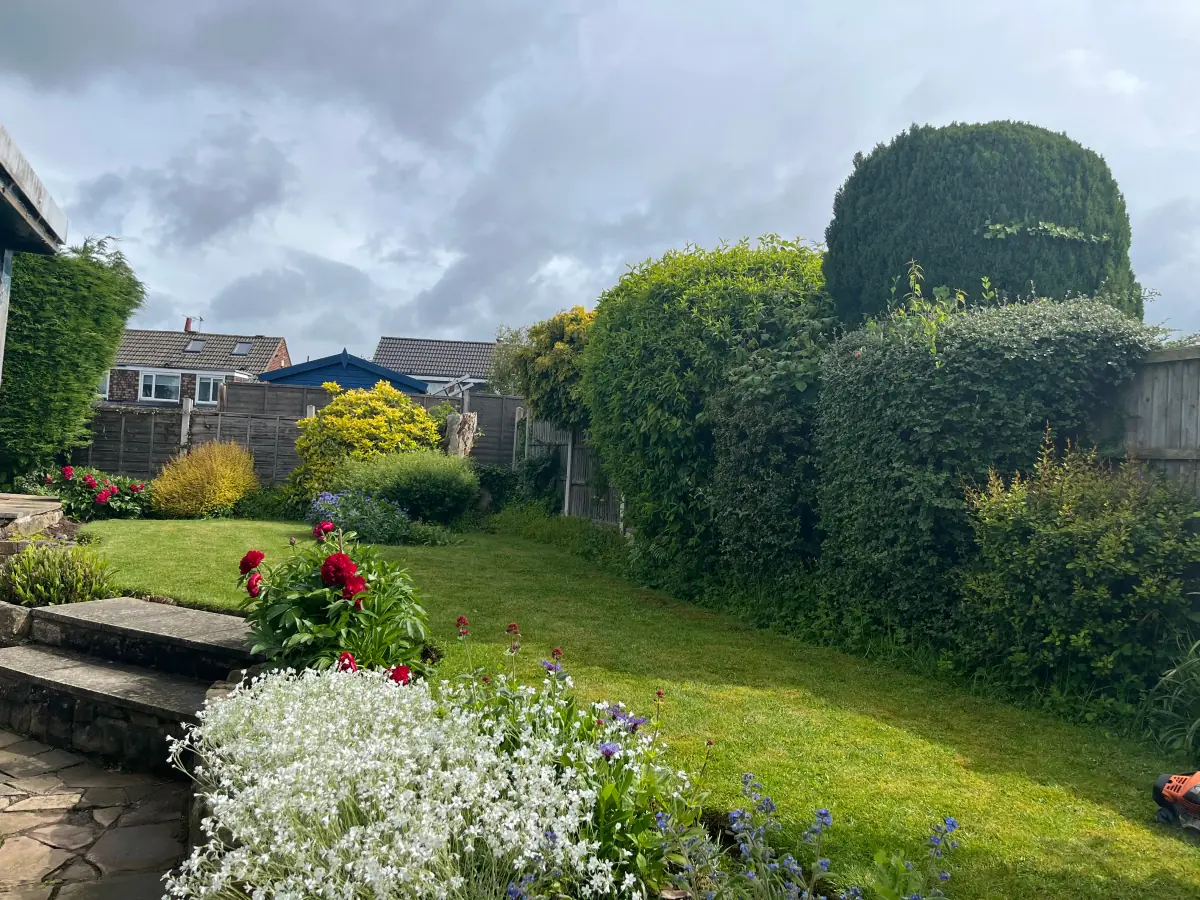
Cut a leylandii or conifer hedge between April and the end of August, and never into bare brown wood. That is the whole rule. The timing keeps the hedge green, and the depth keeps it alive. The calendar below is built on the Royal Horticultural Society’s hedge pruning guidance and on what we see on conifer boundaries across Leeds and York every summer.
When to cut each conifer
| Hedge | When to trim | How often | Regrows from old wood? |
|---|---|---|---|
| Leylandii (Leyland cypress) | April to end of August | Two or three cuts | No |
| Lawson cypress | Spring and summer | Twice | No |
| Thuja (western red cedar) | Spring, then early autumn | Twice | Only a little, and not reliably |
| Yew | Summer and early autumn | Once or twice | Yes |
Two things on that table matter more than the rest. First, the RHS is blunt that trimming conifers after August encourages bare patches, so the season ends earlier than most people think. Second, the last column decides what happens when a hedge has got away from you: everything except yew has a hard limit on how far back it can go.
Deciduous and broadleaf hedges run to a different calendar. Laurel and beech both get their own guides: when to cut a laurel hedge and when to trim a beech hedge.
Why the season ends in August
A conifer hedge greens over a cut by pushing new growth from the green shoots just inside the cut face. That takes several weeks of growing weather. Trim in late September and the cut ends sit exposed through the first frosts with nothing grown over them, and the brown edges you get in November are there to stay.
So the pattern for a formal leylandii hedge is a first cut in April once growth starts, a second in June or July, and a last light one before the end of August. If you only manage one, make it the August one, and get it done in the month rather than the week after.
The brown wood rule
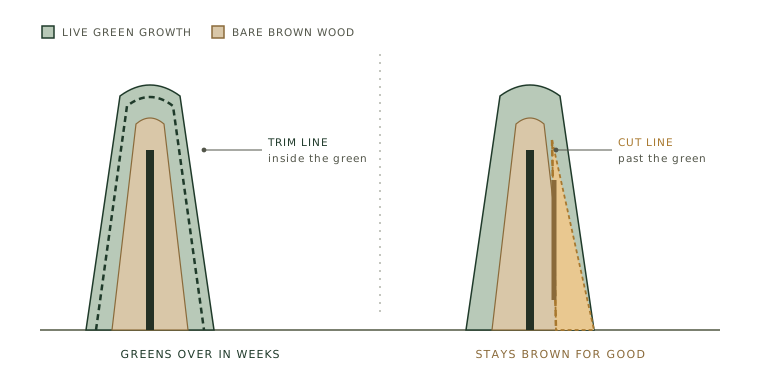
This is the part that catches out more people than the calendar. Leylandii, Lawson cypress and most other conifers carry all their live growth in a green outer layer a few inches deep. Inside that is bare wood with no buds on it. Cut back past the green and there is nothing to regrow from, so the face you have exposed stays brown for good. It does not fill in next year, or the year after.
Every trim therefore has to stay within the green. On a hedge that is clipped two or three times a year that is easy, because the green layer is dense and the hedge never gets far from the line. On a hedge that has been left for five years it is the problem, because the line you want is now inside the brown.
Yew is the one conifer that plays by broadleaf rules. It regrows from old wood, so an overgrown yew can be cut back hard and will come back, staged over two seasons like a beech. Thuja will sometimes push a little growth from older wood, but not reliably enough to plan a renovation around.
How much can you take off an overgrown leylandii?
Less than you want to. The RHS guidance for a conifer hedge that has grown too tall is a reduction of no more than one-third of the height, done in April, so the hedge has the whole growing season to recover. Take more than that off the top and the hedge is likely to stay flat and bare up there.
The sides are worse, because that is where the brown wood rule bites. A leylandii that has spread a metre past the fence cannot be shorn back to the fence, because the fence line is now deep in bare wood. What you can do is thin the sides, taking selected branches right back to the trunk so light gets in, and hold the outer face where the green allows. That narrows the hedge a little and keeps it alive; it does not give you the metre back.
Which is why the honest answer on a badly overgrown conifer boundary is often a one-off heavy reduction to whatever green is left, or removal and replanting. We set that out, with guide figures, in our hedge removal cost guide.
Nesting birds
The conifer trimming window and the main bird nesting season, roughly March to August, overlap for almost the whole season, and a dense leylandii is about the best nesting cover a garden offers. It is an offence to damage or destroy a nest in use, so the calendar does not excuse you from checking. Walk the length of the hedge and look into it before each cut, and if a section has a nest in it, leave that section until the brood has gone. The legal detail, along with the boundary and the high hedges rules, is in our guide to hedge cutting and the law.
Keeping a conifer hedge green to the ground
Brown at the bottom of an otherwise healthy hedge is nearly always a shape problem rather than disease. A hedge that is wider at the top than the base shades its own lower growth, and shaded conifer growth dies and does not come back. Cut every face with a slight batter so the base is a few centimetres wider than the top, and the lowest growth stays in the light.
The other cause is neglect at the base. Leylandii grows fastest at the top, so a hedge that gets one hurried cut a year tends to be trimmed hard on top and barely touched low down, and the batter reverses itself over a few seasons.
Past the point a trim can fix?
If the green is gone from where you need the hedge to be, we will tell you straight whether a one-off heavy reduction will hold it or whether it is a removal. WhatsApp us a photo of the hedge and we will give you an honest view, no pressure either way.
When to call us
A conifer hedge you can reach from the ground, cut two or three times a summer, is a DIY job. It stops being one when the hedge is over head height on the far side, when a boundary neighbour is involved, or when it has been left long enough that the line you want is inside the brown. At that point the question is whether a heavy reduction to green will hold it or whether it is coming out. Our hedge removal service covers both, with the stumps ground out and everything taken away, across Leeds, York and the villages between. Get in touch for a free quote.