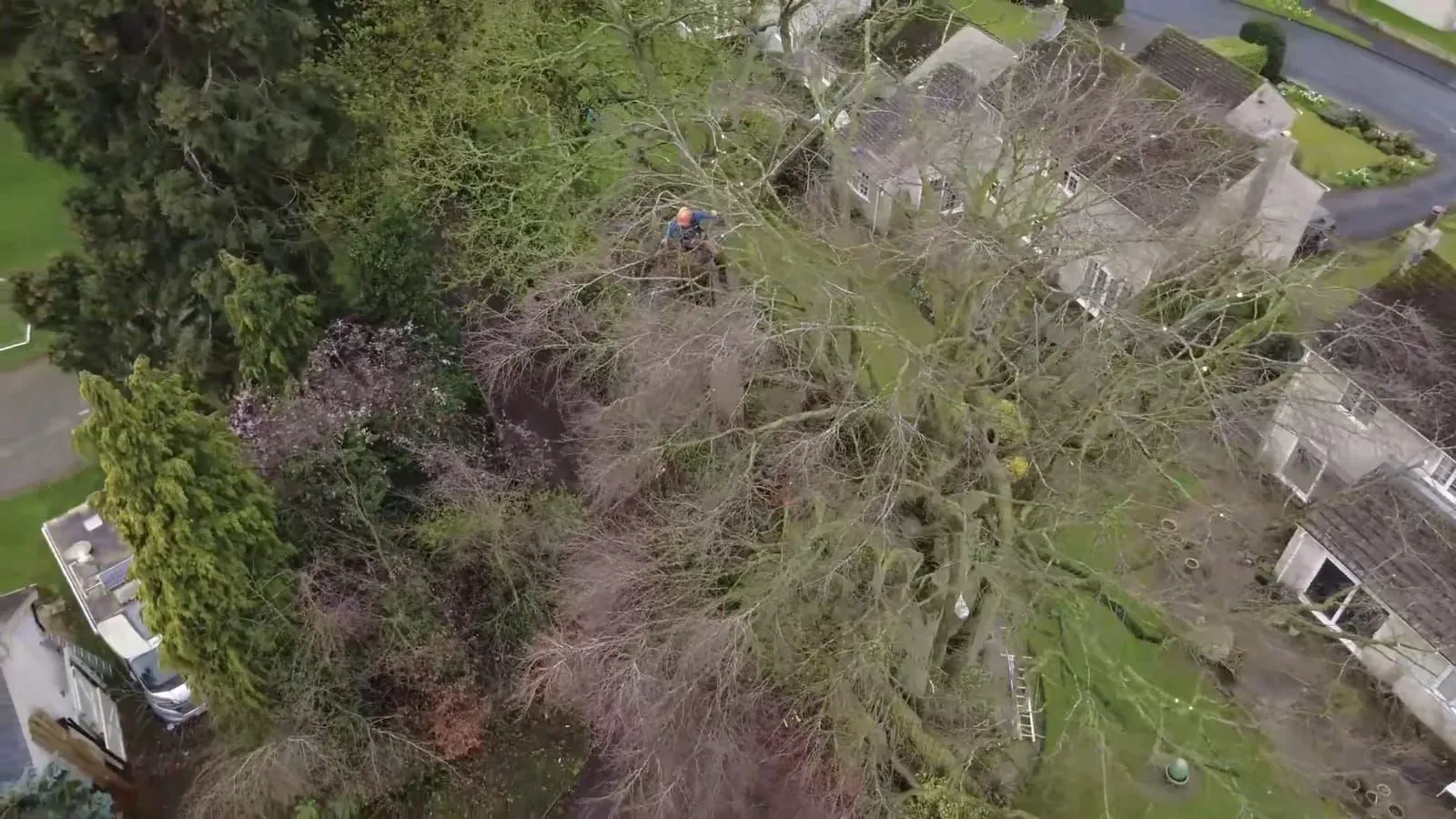
If ivy is climbing a tree in your Leeds or York garden, the honest answer is that it is almost certainly not killing it. Ivy (Hedera helix) is not a parasite. It takes no food or water from the tree, it simply uses the trunk as a ladder to reach the light, gripping with tiny aerial rootlets that cling to the bark without feeding on it.
That surprises a lot of people, because the folklore says ivy strangles trees. It usually does not. A healthy, vigorous tree in an older garden or on a boundary line copes with ivy perfectly well, often for decades. So before you reach for a saw, it is worth understanding when ivy genuinely matters and when it does not.
What ivy actually does to a tree
Ivy is a climber, not a strangler. It roots in the ground and draws its own water and nutrients from the soil, exactly like any other plant. The rootlets you see gripping the bark are anchors, not feeding structures. They do not tap into the tree’s sap.
This is the part most advice skips. Ivy and the tree are two separate plants sharing the same space. The ivy is not stealing anything from inside the trunk.
Because of that, a strong tree with a full, healthy crown of its own leaves usually stays ahead of the ivy with no trouble at all. The problems, when they come, are indirect. They are about weight, wind and what the ivy hides, not about the ivy feeding on the tree.
When ivy IS a genuine problem
Ivy earns its bad reputation on trees that are already vulnerable. On those, it can tip a marginal tree over the edge. Here is where a real arborist starts paying attention.
| Concern | Why it matters |
|---|---|
| Hides defects from inspection | Dense ivy conceals cracks, cavities, decay and fungal brackets on the trunk, so a serious structural fault can go unseen until it fails. |
| Adds sail area and windage | A trunk wrapped in evergreen ivy catches far more winter wind than a bare one, raising the load on an already weak stem or root plate. |
| Adds weight to the crown | Ivy holds its leaves through winter storms, adding weight up high exactly when gales are strongest and failure risk is highest. |
| Outcompetes weak trees for light | On a young, newly planted or already stressed tree, vigorous ivy can smother the canopy and steal the light the tree needs. |
| Masks root and base problems | Heavy ivy around the base and root flare can hide root decay, basal cavities and lifting soil, the very things that predict a whole-tree failure. |
The pattern is clear. On a healthy tree, none of these are pressing. On a suspect or storm-exposed tree, every one of them matters, and the ivy stops being cosmetic and becomes a safety question. Once the trunk is visible, our guide to the signs of a dangerous tree lists what to check.
The upside of ivy, stated honestly
It would be dishonest to tell you to strip every tree bare. Ivy is genuinely valuable. It flowers very late in the year, giving nectar to bees and other insects when almost nothing else is blooming, and its black berries feed birds through winter.
The dense evergreen growth also gives nesting and roosting cover for birds and shelter for insects and bats. The Woodland Trust and the Royal Horticultural Society both rate common ivy as a strong wildlife plant rather than a pest.
So the default is not “always remove it”. The default is to look at the specific tree and decide.
The arborist decision rule
After years of doing this work across east Leeds and out towards York, the decision comes down to three simple cases. This is the honest version of what a good tree surgeon actually does.
| Tree situation | What to do |
|---|---|
| Healthy, vigorous tree | Leave the ivy on. It is doing no harm and it is feeding wildlife. |
| Suspect trunk you need to inspect | Sever the ivy at the base and let it die back, so the bark can be seen and checked. |
| Weak or storm-exposed tree | Reduce the windage and weight, which usually means crown work as well as ivy removal. |
That middle and third case are where a professional survey or crown work comes in. If a tree is holding a lot of ivy and you cannot see the trunk to judge it, a crown reduction combined with clearing the ivy lets us both lighten the load and inspect the structure properly. On boundary and roadside trees, that inspection is often the whole point.
How to kill ivy on a tree, the honest version
Here is where the generic advice goes wrong. Searching how to kill ivy throws up weedkiller and brute-force methods, but on a tree the right approach is much gentler and it is mostly about patience.
The DIY method that works
For ivy you can safely reach from the ground, on a sound tree, the method is simple:
- Cut through every ivy stem in a band around the base of the trunk with a pruning saw or loppers.
- Remove a hand’s width of stem so the cut ends cannot rejoin.
- Leave the top growth exactly where it is and let it die back over the following weeks and months.
The single most important rule: do not rip live ivy off the bark. Tearing it away pulls at the tree’s outer protective layer and can strip bark, opening the tree up to disease. Once the severed ivy above your cut is fully dead and brittle, it loosens and drops away on its own with far less damage.
When it becomes a pro job
Some ivy jobs are not DIY, and pretending otherwise is how people get hurt or wreck a tree.
| The job involves | Why it is a professional job |
|---|---|
| A chainsaw | Chainsaw work in a tree needs training, kit and insurance. |
| Working at height | Ivy up a tall trunk means climbing or a platform, not a wobbly ladder. |
| A defect-laden tree | On a decayed stem, a hard DIY yank can drop a dead branch, or worse, a widow-maker. |
A cheap DIY tug on the wrong tree can pull bark, snap a hidden dead limb or bring a heavy tangle of ivy and deadwood down on top of you. If any of those factors are in play, it is worth getting it priced properly. Our guide to tree surgery costs gives you a realistic idea of what professional ivy and crown work runs to before you ask for a quote.
Check for nesting birds first
Before you cut a single ivy stem, check it carefully for birds. Ivy is a favourite nesting spot, and it is a criminal offence to intentionally damage or destroy an active nest under the Wildlife and Countryside Act.
Nesting season runs roughly from March to August. In that window, look and listen properly before cutting, and if you find an active nest, stop and wait until the young have fledged. The RSPB and gov.uk both set out the rules, and the responsibility sits with whoever does the cutting.
Not sure if your ivy is a problem?
Send a photo and we will give you the honest answer, no upsell. WhatsApp us a photo of the tree or book a free site visit and we will tell you whether to leave it, sever it or reduce it.
Ivy on older Leeds and York trees
A lot of the ivy questions we get are on mature boundary and garden trees in older properties around Garforth, Wetherby, Tadcaster and out towards Selby and York. These are exactly the trees where the sensible approach matters most.
Older gardens tend to have large, established trees near fences, drives and neighbours. That is where hidden trunk defects and winter windage carry real consequences, and where a proper look under the ivy is worth doing. It is also where the wildlife value is highest, so blanket stripping is rarely the right call.
The honest summary: ivy on a healthy tree is a feature, not a fault. Ivy on a suspect or exposed tree is a reason to inspect and, sometimes, to reduce the crown. The skill is telling the two apart, and that is what a site visit is for.
If you have ivy on a tree and you are not sure which category it falls into, tell us about your tree and we will give you a straight answer.